Field guide
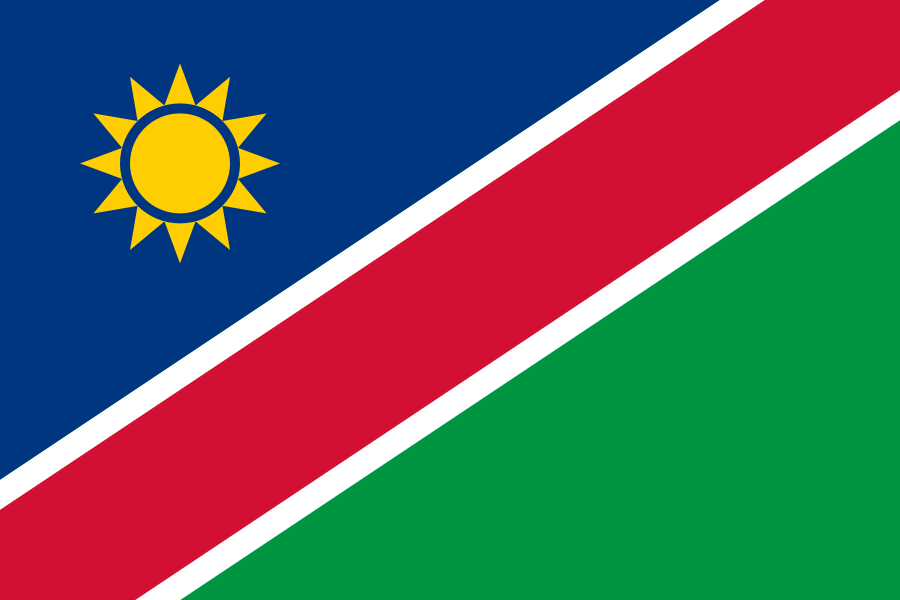
Namibia
NA, Namibië, Republic of Namibia
This page stitches together our stored feeds—expect warm, human-readable snippets rather than dry data tables.
Names & aliases
Quick facts
Need-to-know at a glance
Capital
Windhoek
Currency
Namibian dollar (NAD) · $
Languages
Afrikaans, German, English, Herero, Khoekhoe, Kwangali, Lozi, Ndonga, Tswana
Population
3,022,401
Area
825,615 km²
Calling code
+264
Driving side
Left-hand
Pre-trip intel
Safety & entry
Advisories and border basics from our stored feeds.
On the ground
Getting around & connectivity
Practical notes from Wikivoyage sections.
Transport
Getting around
There are 9 commonly used border posts with neighbouring countries:
- There are 9 commonly used border posts with neighbouring countries:
Local wisdom
Etiquette, tipping & staying well
Etiquette & respect
Namibia shares many similarities with its neighbours, particularly with South Africa, and if you're used to travelling in the region, Namibia should be a seamless transition from the latter. However, there are some subtle differences. For example, in South Africa a black South African may choose to speak English rather than Afrikaans (as a political choice) whereas among Namibia's mixed-race population (who call themselves 'coloured' in Namibia and South Africa) Afrikaans is a proud part of their culture, and many people still speak German. Overlooking these differences isn't going to cause offence, but they're handy to know. The pu…
Etiquette & respect
Namibia shares many similarities with its neighbours, particularly with South Africa, and if you're used to travelling in the region, Namibia should be a seamless transition from the latter. However, there are some subtle differences. For example, in South Africa a black South African may choose to speak English rather than Afrikaans (as a political choice) whereas among Namibia's mixed-race population (who call themselves 'coloured' in Namibia and South Africa) Afrikaans is a proud part of their culture, and many people still speak German. Overlooking these differences isn't going to cause offence, but they're handy to know. The pu…
- Namibia shares many similarities with its neighbours, particularly with South Africa, and if you're used to travelling in the region, Namibia should be a seamless transition from the latter. However, there are some subtle differences. For example, in South Africa a black South African may choose to speak English rather than Afrikaans (as a political choice) whereas among Namibia's mixed-race population (who call themselves 'coloured' in Namibia and South Africa) Afrikaans is a proud part of their culture, and many people still speak German. Overlooking these differences isn't going to cause offence, but they're handy to know.
- The public holidays in Namibia are:
- If a holiday falls on a Saturday or Sunday, many businesses will give the previous, or the following, day off, and be closed.
Tipping guidance
No summary available.
Needs review
Tipping guidance
No summary available.
No bullet notes stored.
Health & wellness
The HIV infection rate in Namibia is around 17%, which is lower than before but is still the leading cause of death in the country. Namibia's medical system is modern and capable of attending to whatever needs you may have. Staff are well trained and so HIV transmission in hospitals is not an issue. This applies to government and private hospitals alike, though line-ups are often shorter at private hospitals, and there have been cases of incorrect diagnosis in government hospitals. Should you become a victim of violence, private doctors and hospitals will send you away. The reason is that staff treating you will be summoned as witnesses to subsequent court cases without compensation, and lose valuable working time. In state hospitals, where productivity is not an issue, you will be treated at almost no charge. Thereafter do consult a private practice to confirm diagnosis and treatment. All private medical facilities expect cash or credit card in advance, no matter if or where you are insured. A visit to the doctor will be about 500 N$, for a night in hospital you'll have to deposit at least 10,000 N$. The northern part of Namibia is in a malaria-risk zone, so consult a doctor before leaving, and take appropriate malaria precautions when travelling in these areas. Ensure you are well stocked with water when journeying through the hot and sparsely populated country. On main roads take along at least 2 liters of potable water per person. In lesser travelled areas, 5 litres per person are the absolute minimum. If your car breaks down it can take days (!) for someone else to pass through. Namibia's water supply is usually safe to drink, except where labelled otherwise. Campsites next to rivers often get their water directly from the river. This water is clean but still disturbs some stomachs. Windhoek has the oldest direct water reclamation plant in the world. "Direct" means toilet-to-tap in one go, and many Windhoekers are uncomfortable with that and only drink bottled water. However, the water is completely safe, it just doesn't taste very good. Having said all this, make sure you consult a physician specializing in health issues of Southern Africa, as well as things like the [http://www.cdc.gov/ Centre for Disease Control] web page. Make sure you satisfy yourself of the safety of anything you're getting into.
Health & wellness
The HIV infection rate in Namibia is around 17%, which is lower than before but is still the leading cause of death in the country. Namibia's medical system is modern and capable of attending to whatever needs you may have. Staff are well trained and so HIV transmission in hospitals is not an issue. This applies to government and private hospitals alike, though line-ups are often shorter at private hospitals, and there have been cases of incorrect diagnosis in government hospitals. Should you become a victim of violence, private doctors and hospitals will send you away. The reason is that staff treating you will be summoned as witnesses to subsequent court cases without compensation, and lose valuable working time. In state hospitals, where productivity is not an issue, you will be treated at almost no charge. Thereafter do consult a private practice to confirm diagnosis and treatment. All private medical facilities expect cash or credit card in advance, no matter if or where you are insured. A visit to the doctor will be about 500 N$, for a night in hospital you'll have to deposit at least 10,000 N$. The northern part of Namibia is in a malaria-risk zone, so consult a doctor before leaving, and take appropriate malaria precautions when travelling in these areas. Ensure you are well stocked with water when journeying through the hot and sparsely populated country. On main roads take along at least 2 liters of potable water per person. In lesser travelled areas, 5 litres per person are the absolute minimum. If your car breaks down it can take days (!) for someone else to pass through. Namibia's water supply is usually safe to drink, except where labelled otherwise. Campsites next to rivers often get their water directly from the river. This water is clean but still disturbs some stomachs. Windhoek has the oldest direct water reclamation plant in the world. "Direct" means toilet-to-tap in one go, and many Windhoekers are uncomfortable with that and only drink bottled water. However, the water is completely safe, it just doesn't taste very good. Having said all this, make sure you consult a physician specializing in health issues of Southern Africa, as well as things like the [http://www.cdc.gov/ Centre for Disease Control] web page. Make sure you satisfy yourself of the safety of anything you're getting into.
- The HIV infection rate in Namibia is around 17%, which is lower than before but is still the leading cause of death in the country.
- Namibia's medical system is modern and capable of attending to whatever needs you may have. Staff are well trained and so HIV transmission in hospitals is not an issue. This applies to government and private hospitals alike, though line-ups are often shorter at private hospitals, and there have been cases of incorrect diagnosis in government hospitals. Should you become a victim of violence, private doctors and hospitals will send you away. The reason is that staff treating you will be summoned as witnesses to subsequent court cases without compensation, and lose valuable working time. In state hospitals, where productivity is not an issue, you will be treated at almost no charge. Thereafter do consult a private practice to confirm diagnosis and treatment. All private medical facilities expect cash or credit card in advance, no matter if or where you are insured. A visit to the doctor will be about 500 N$, for a night in hospital you'll have to deposit at least 10,000 N$.
- The northern part of Namibia is in a malaria-risk zone, so consult a doctor before leaving, and take appropriate malaria precautions when travelling in these areas.
- Ensure you are well stocked with water when journeying through the hot and sparsely populated country. On main roads take along at least 2 liters of potable water per person. In lesser travelled areas, 5 litres per person are the absolute minimum. If your car breaks down it can take days (!) for someone else to pass through. Namibia's water supply is usually safe to drink, except where labelled otherwise. Campsites next to rivers often get their water directly from the river. This water is clean but still disturbs some stomachs. Windhoek has the oldest direct water reclamation plant in the world. "Direct" means toilet-to-tap in one go, and many Windhoekers are uncomfortable with that and only drink bottled water. However, the water is completely safe, it just doesn't taste very good.
- Having said all this, make sure you consult a physician specializing in health issues of Southern Africa, as well as things like the [http://www.cdc.gov/ Centre for Disease Control] web page. Make sure you satisfy yourself of the safety of anything you're getting into.
Scams & street smarts
Namibia is a peaceful country and is not involved in any wars. Since the end of the Angolan civil war in May 2002, the violence that spilled over into northeastern Namibia is no longer an issue. Namibia is, however, a country with extreme income disparities. A middle manager easily earns twenty times the salary of a cleaner, and a third of the workforce is unemployed. As a tourist you're inevitably seen as stinking rich, and a prime target for thieves. Namibia has a relatively high crime rate, particularly sexual abuse, general violence after alcohol abuse, and theft. Be careful on or right after pay day, the last day of the month, when there will be more drunk people than usual. Travellers should have no problem visiting the townships, but do not go there on your own, or after dark. In Windhoek you can book township tours where you will be taken to the most interesting places, but that's not the same as going there yourself and seeing that there are people living there like you and me. For foreigners, it is not prudent to walk or ride taxis alone after sunset. Pickpockets can be a problem. No local will carry a bag while walking, and for thieves the bag is the token to make out who is a tourist and who isn't. Stuff all possessions into your trouser pockets. If you rent a car, insist that the owner (the rental company) of the car is clearly visible with stickers or as car paint. In the event of carjacking there is no easier way to relax the attitude of the robbers than pointing out that the car isn't yours. Besides, as pretty much all rented cars have hidden communication devices, no carjacker in his right mind will take one from a rental company. Most reported robberies take place just outside of the city centre. The police report that taxi drivers are often involved: they spot vulnerable tourists and coordinate by cell phoning. Take these warnings in context; if you are alert and take some common sense precautions, you should have no problems. Never be specific when asked where you are staying; "in town" or "at some B&B" is sufficient for all good-faith conversations and doesn't disclose your intended route. Namibia has a serious problem with driving under the influence of alcohol. The problem is aggravated because most people consider it no problem. When driving or walking on weekend evenings, be especially alert. The person in a car (the more expensive the better) is more important, and has the right of way. This specifically includes zebra crossings and green pedestrian traffic lights—even expats and fellow tourists will not stop for someone on foot in order not to confuse local drivers.
Scams & street smarts
Namibia is a peaceful country and is not involved in any wars. Since the end of the Angolan civil war in May 2002, the violence that spilled over into northeastern Namibia is no longer an issue. Namibia is, however, a country with extreme income disparities. A middle manager easily earns twenty times the salary of a cleaner, and a third of the workforce is unemployed. As a tourist you're inevitably seen as stinking rich, and a prime target for thieves. Namibia has a relatively high crime rate, particularly sexual abuse, general violence after alcohol abuse, and theft. Be careful on or right after pay day, the last day of the month, when there will be more drunk people than usual. Travellers should have no problem visiting the townships, but do not go there on your own, or after dark. In Windhoek you can book township tours where you will be taken to the most interesting places, but that's not the same as going there yourself and seeing that there are people living there like you and me. For foreigners, it is not prudent to walk or ride taxis alone after sunset. Pickpockets can be a problem. No local will carry a bag while walking, and for thieves the bag is the token to make out who is a tourist and who isn't. Stuff all possessions into your trouser pockets. If you rent a car, insist that the owner (the rental company) of the car is clearly visible with stickers or as car paint. In the event of carjacking there is no easier way to relax the attitude of the robbers than pointing out that the car isn't yours. Besides, as pretty much all rented cars have hidden communication devices, no carjacker in his right mind will take one from a rental company. Most reported robberies take place just outside of the city centre. The police report that taxi drivers are often involved: they spot vulnerable tourists and coordinate by cell phoning. Take these warnings in context; if you are alert and take some common sense precautions, you should have no problems. Never be specific when asked where you are staying; "in town" or "at some B&B" is sufficient for all good-faith conversations and doesn't disclose your intended route. Namibia has a serious problem with driving under the influence of alcohol. The problem is aggravated because most people consider it no problem. When driving or walking on weekend evenings, be especially alert. The person in a car (the more expensive the better) is more important, and has the right of way. This specifically includes zebra crossings and green pedestrian traffic lights—even expats and fellow tourists will not stop for someone on foot in order not to confuse local drivers.
- Namibia is a peaceful country and is not involved in any wars. Since the end of the Angolan civil war in May 2002, the violence that spilled over into northeastern Namibia is no longer an issue. Namibia is, however, a country with extreme income disparities. A middle manager easily earns twenty times the salary of a cleaner, and a third of the workforce is unemployed. As a tourist you're inevitably seen as stinking rich, and a prime target for thieves.
- Namibia has a relatively high crime rate, particularly sexual abuse, general violence after alcohol abuse, and theft. Be careful on or right after pay day, the last day of the month, when there will be more drunk people than usual. Travellers should have no problem visiting the townships, but do not go there on your own, or after dark. In Windhoek you can book township tours where you will be taken to the most interesting places, but that's not the same as going there yourself and seeing that there are people living there like you and me.
- For foreigners, it is not prudent to walk or ride taxis alone after sunset. Pickpockets can be a problem. No local will carry a bag while walking, and for thieves the bag is the token to make out who is a tourist and who isn't. Stuff all possessions into your trouser pockets. If you rent a car, insist that the owner (the rental company) of the car is clearly visible with stickers or as car paint. In the event of carjacking there is no easier way to relax the attitude of the robbers than pointing out that the car isn't yours. Besides, as pretty much all rented cars have hidden communication devices, no carjacker in his right mind will take one from a rental company.
- Most reported robberies take place just outside of the city centre. The police report that taxi drivers are often involved: they spot vulnerable tourists and coordinate by cell phoning. Take these warnings in context; if you are alert and take some common sense precautions, you should have no problems. Never be specific when asked where you are staying; "in town" or "at some B&B" is sufficient for all good-faith conversations and doesn't disclose your intended route.
- Namibia has a serious problem with driving under the influence of alcohol. The problem is aggravated because most people consider it no problem. When driving or walking on weekend evenings, be especially alert. The person in a car (the more expensive the better) is more important, and has the right of way. This specifically includes zebra crossings and green pedestrian traffic lights—even expats and fellow tourists will not stop for someone on foot in order not to confuse local drivers.
Tempo & rhythm
Climate & timezones
Ground truth from Open-Meteo, REST Countries, and webcams.
Climate (Capital proxy)
Jan
23°C
121 mm
Feb
22°C
98 mm
Mar
22°C
75 mm
Apr
20°C
27 mm
May
16°C
5 mm
Jun
13°C
0 mm
Jul
13°C
1 mm
Aug
16°C
0 mm
Sep
20°C
6 mm
Oct
22°C
13 mm
Nov
23°C
26 mm
Dec
24°C
52 mm
Timezones
UTC offsets
Webcam IANA zones
- Africa/Windhoek6 cams
Practicalities
Money & essentials
Money & costs
GDP per capita: $4,413.128 · 2024
GDP (PPP): $11,686.602 · 2024
Inflation: 4.2% · 2024
Currency: Namibian dollar (NAD) · $
Power & plugs
Highlights
Top places to explore
- 01
, capital of Omaheke
- 02
, capital of the Zambezi region in the Caprivi Strip
- 03
, capital of ǁKaras
- 04
, the capital of Hardap
- 05
, capital of Erongo and a mecca for Namibians on holiday
Cams
Cams in this country
Live feeds indexed across our network.
Total webcams
6
Categories
WILDLIFE: 3 · HARBOR: 2 · AIRPORT: 1
Top cities
Plan
Plan your trip
Curated partners for flights, beds, insurance, and more.
Flights via Skyscanner
Hotels via Booking.com
Travel Insurance via SafetyWing
Guided Tours via Viator
International eSIM via Airalo
Links are templates; confirm final tracking codes before launch.
Sources
Attribution & provenance
Every wiki block is pulled from these stored responses.
REST Countries
December 21, 2025 at 11:34 PM · HTTP 200
OK
REST Countries
December 21, 2025 at 11:34 PM · HTTP 200
Source ID: restCountries
Visit sourceU.S. Department of State
December 21, 2025 at 11:34 PM · HTTP 200
OK
U.S. Department of State
December 21, 2025 at 11:34 PM · HTTP 200
Source ID: stateDeptAdvisory
Visit sourceOpen-Meteo Climate
December 21, 2025 at 11:34 PM · HTTP 200
OK
Open-Meteo Climate
December 21, 2025 at 11:34 PM · HTTP 200
Source ID: openMeteoClimate
Visit sourceWikivoyage
December 21, 2025 at 11:34 PM · HTTP 200
OK
Wikivoyage
December 21, 2025 at 11:34 PM · HTTP 200
Source ID: wikivoyage
Visit sourceWorld Bank GDP per capita
December 21, 2025 at 11:34 PM · HTTP 200
OK
World Bank GDP per capita
December 21, 2025 at 11:34 PM · HTTP 200
Source ID: worldBank:NY.GDP.PCAP.CD
Visit sourceWorld Bank GDP PPP per capita
December 21, 2025 at 11:34 PM · HTTP 200
OK
World Bank GDP PPP per capita
December 21, 2025 at 11:34 PM · HTTP 200
Source ID: worldBank:NY.GDP.PCAP.PP.CD
Visit sourceWorld Bank Inflation (CPI)
December 21, 2025 at 11:34 PM · HTTP 200
OK
World Bank Inflation (CPI)
December 21, 2025 at 11:34 PM · HTTP 200
Source ID: worldBank:FP.CPI.TOTL.ZG
Visit sourceWorldStandards (plugs)
December 21, 2025 at 11:34 PM · HTTP 200
OK
WorldStandards (plugs)
December 21, 2025 at 11:34 PM · HTTP 200
Source ID: powerPlugs
Visit sourceSite provides only human-readable tables; linking instead of parsing.
Webcam DB aggregates
December 21, 2025 at 11:34 PM
OK
Webcam DB aggregates
December 21, 2025 at 11:34 PM
Source ID: webcamDb
Visit sourceAffiliate hub config
December 21, 2025 at 11:34 PM
OK
Affiliate hub config
December 21, 2025 at 11:34 PM
Source ID: affiliateHub
Visit sourceContains information from Wikivoyage, available under CC BY-SA 3.0.